
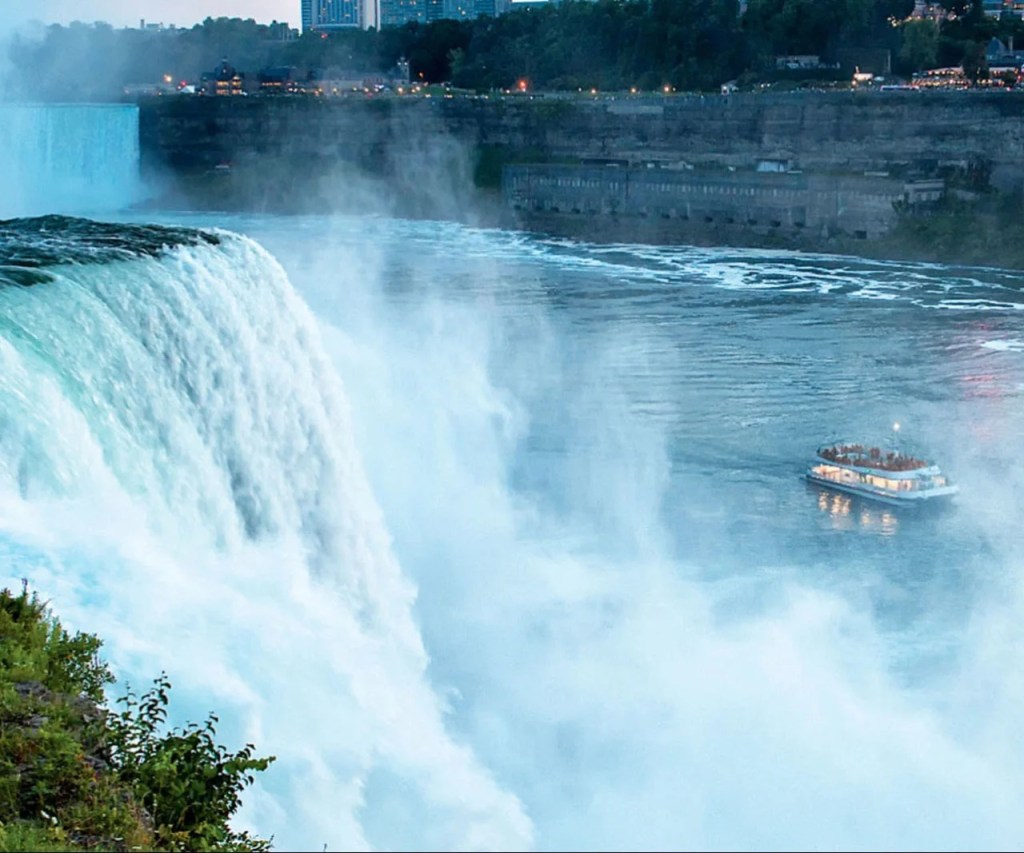
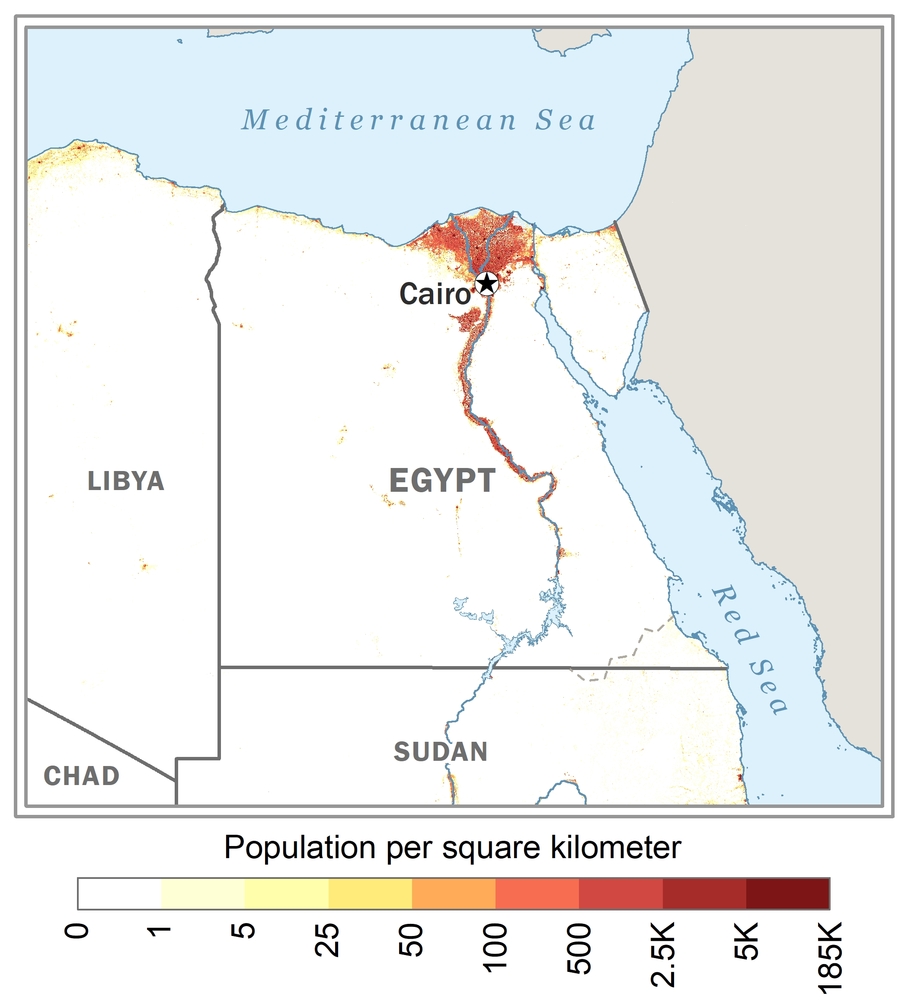
All life on earth congregates around the nearest water source, whether it’s an oasis, wallow, river, ocean, or small creek. Wet regions promote lush plant growth which provides food for a wide array of animals. Humans are no different; our bodies are heavily dependent on water for their survival. Water has also proven to be a place where people come together and thrive, harvesting and trading the region’s resources, and building connective networks between communities. For example, 95% of Egypt’s population lives along the Nile river, the main source of water in the otherwise dry country. As our population has grown, we have manipulated the environment to bring water everywhere we step foot. In today’s world, our societies are designed so that most people have more water than they could ever need at their fingertips. We tend to take water for granted, forgetting just how important it is to us.
Between 2 and 3 million years ago, humans evolved to be taller and skinnier, decreasing ultraviolet (UV) exposure and increasing exposure to wind, making us more water efficient. As we evolved to live in grasslands, we became more bipedal, developed more sweat glands, and lost body hair. These changes made humans better at shedding excess heat. Mammals have three types of sweat glands: apocrine, sebacious, and eccrine. Eccrine sweat glands mobilize the water and electrolytes inside cells to produce sweat. Evaporation of sweat cools the skin and blood vessels, cooling the body’s core. Humans have more eccrine sweat glands than any other primate, improving our cooling system and increasing our ability to be active. Our efficient cooling system allowed us to run for extended periods of time without suffering from heatstroke. With humanity’s newfound endurance, we were able to outrun our prey by chasing them until they succumbed to heat stroke or simply became to exhausted to run farther.
Along with the benefits of an efficient cooling system came the drawback of dehydration.
Managing dehydration is a more pressing problem for humans than other animals. Most animals can lose 20%-40% of their body mass through dehydration. In contrast, humans can only lose 10% of their body mass via dehydration before risking physiological or cognitive problems or even death. In addition, humans ability to rehydrate is limited by our gut size, the rate at which our stomach empties, and the possibility of developing hyponatremia (over-hydration) from excessively rapid water intake. We can take over 24 hours to fully recover from extreme water losses, even under favorable conditions.

As a result, hydration has been a reoccurring struggle across the world and throughout history. In older civilizations, locating safe sources of water in the region was passed down generations as a learned skill. In more recent times, fermented beverages, such as wine or beer, became a staple for hydration in many societies because they are naturally free of bacteria. The romans developed a particularly memorable method for bringing water to their cities. Roman aqueducts still stand today as a reminder of what we will do to fill our most basic and pressing needs.Today, purified water is much easier to get than it once was, but even in the United States, where there is a plentiful supply of clean water, dehydration claims 10,000 lives each year.
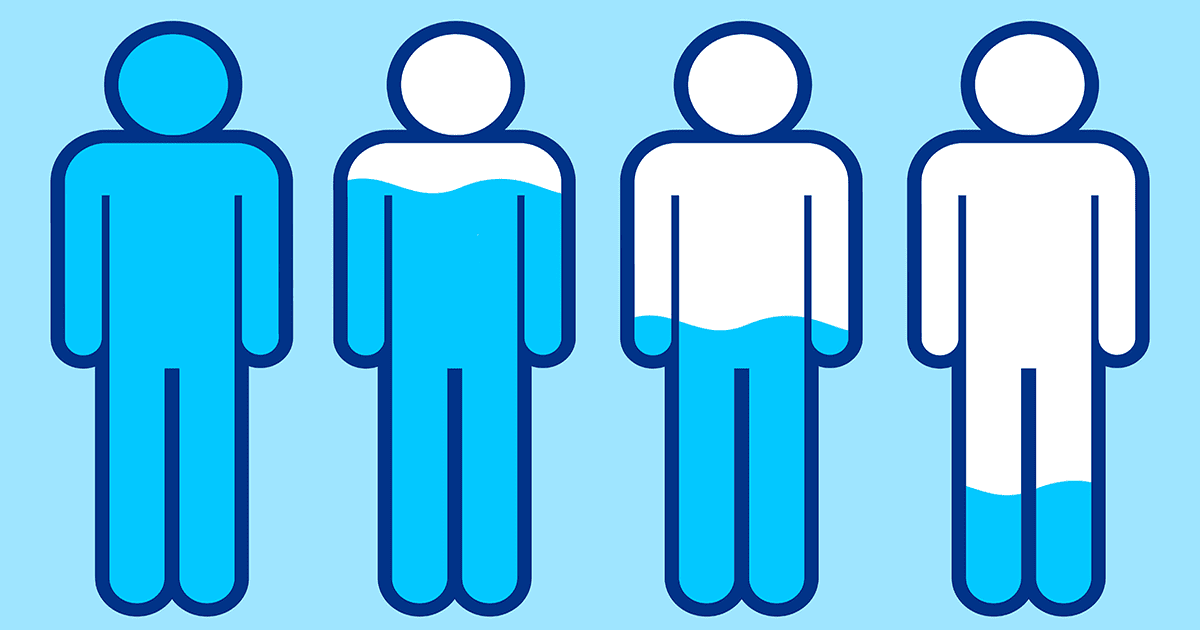
Death to dehydration starts small but builds quickly. Your brain begins to send you thirst cues once you’ve lost around 2% of your body weight through fluids. At that point the mouth and throat start to feel dry. You might experience lightheadedness and headaches. Your body will preserve its remaining water, concentrating your blood and sending less to the bladder. This leads to a higher concentration of impurities in your urine, making it appear darker. Once you lose roughly 4% of your body weight through dehydration, your blood becomes thick enough that blood flow decreases to a degree that makes your skin shrivel. Your low blood pressure will make you prone to fainting. If you lose up to 7% of your weight, your blood pressure will drop further. Blood will be routed away from non-vital organs, such as your kidneys. Loss of your kidneys results in a build-up of cellular waste in your body. The final stage is death by organ failure. Once you lose up to 10% of your body mass, the waste in your blood will build up. Without medical attention, the toxic waste in your blood will cause your vital organs to fail, killing you. Without water, the human body can usually survive for 3 days or even a week.
Throughout history, humans have only been able to go as far as they can bring water. Every couple of hours, after a loss of fluid through vomiting, urination, or sweating, we need more. But humans have also been able to work around our need for water. We’ve brought it with us to the lowest and highest points on earth. We brought it to both the north and south poles. If we’re lucky, it’s brought directly into our homes and is always a couple steps away.
Although the problem appears to be resolved, our need for water isn’t any less severe or consequential. Without recognizing the importance of hydration, we often lose sight of the damage our body takes when we don’t fulfill its needs. When traveling, working, or exercising it can be easy to miss or ignore thirst cues. Even when you’re preoccupied, meeting your body’s needs is worthy of a 5-10 minute break.
 The Hominin Hiker
Leave a comment