
While all skeletons have similarities and differences, there are observable and measurable factors that can give us clues as to whom a skeleton might belong. This is especially important for crime scene investigators: forensic anthropologists are often among the first on the scene and are tasked with using any remains to help identify potential victims. The big four things an anthropologist will be looking to determine are sex, height, age, and ethnic origin. The most important pieces of the skeleton, the pieces that give the most clues, are the skull and the pelvis. Long bones like the femur are also important, especially for height determination, but there’s a lot more to be learned from the skull or the pelvis.
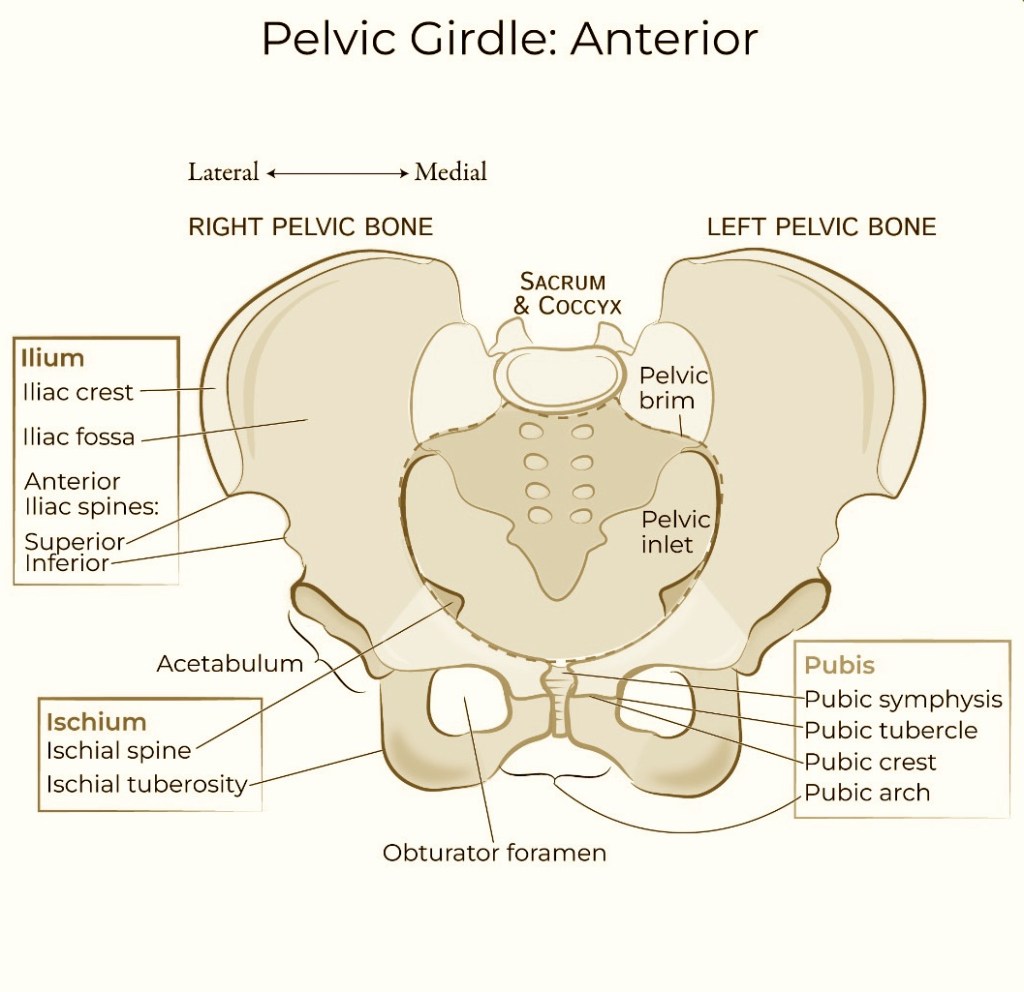
Taking a closer look at sexual determination, the first place to look is the pelvis. Males often have less cartilage, smaller bones, and a narrower hip structure, given that their bodies are not designed for birth. In males, the pubis bone is between 25 and 30 millimeters (mm) thick. In females, the bone is around 40 mm thick. The sub-pubic angle (labeled below as the pubic arch) is less than 90 degrees in males and greater than 90 degrees in females.
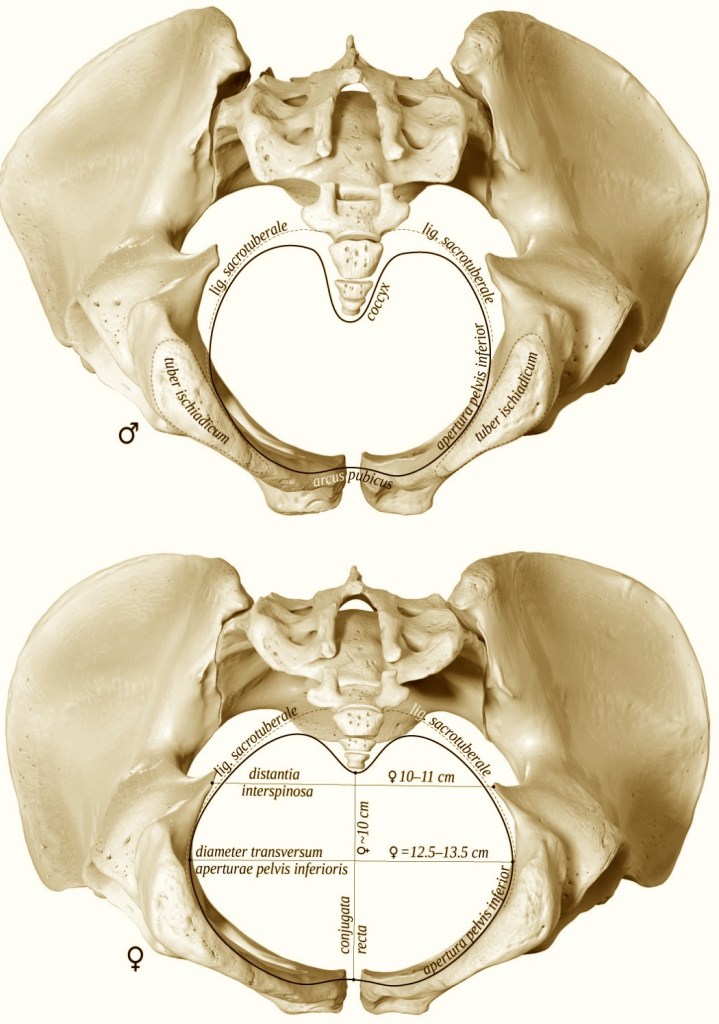
Looking from below, the male pelvis has a coccyx and sacrum that protrude farther into the pelvic inlet, creating a heart-shaped opening. Alternatively, the female pelvic inlet is closer to a circular shape with the coccyx and sacrum arching less into a space that is designed to be a birth canal.
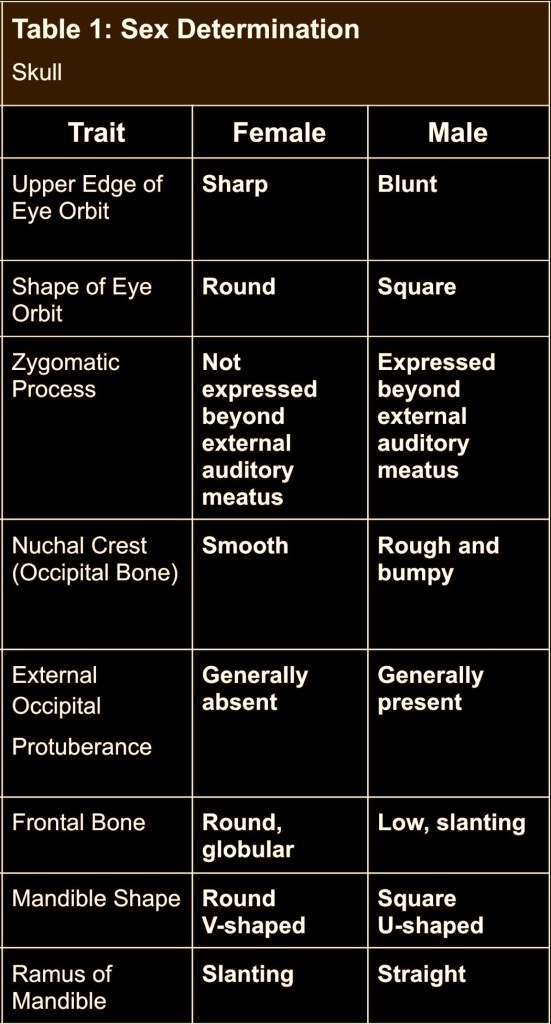
The next place to look for clues as to a skeleton’s sex is its skull. The skull contains many qualitative factors that hint at one sex or the other.
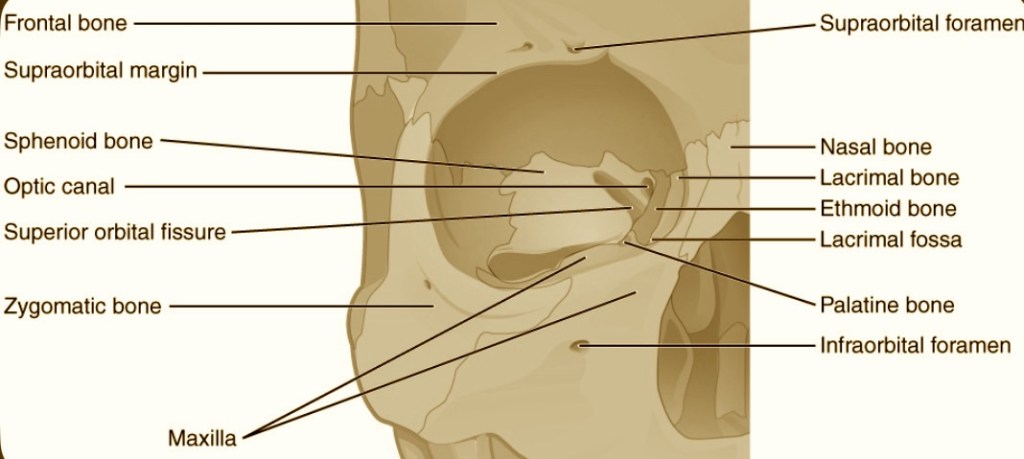
Starting with the eyes, an anthropologist will check both the upper edge and the size of the eye orbit. A female will have a sharper, rounder orbit while a male will have a rounded, square orbit.
The next step to examine the zygomatic process (the cheekbone). In males, the process commonly extends past the auditory meatus while the opposite is true in females.
Then we move to the back of the skull, the occipital bone. If the bone is smooth, it indicates female. If the bone is rough and bumpy, it indicates male. If the external occipital protuberance is present (a small process on the occipital) it also indicates male. Returning to the front of the skull, specifically the frontal bone, we check if the region commonly referred to as the forehead is round or slanting.
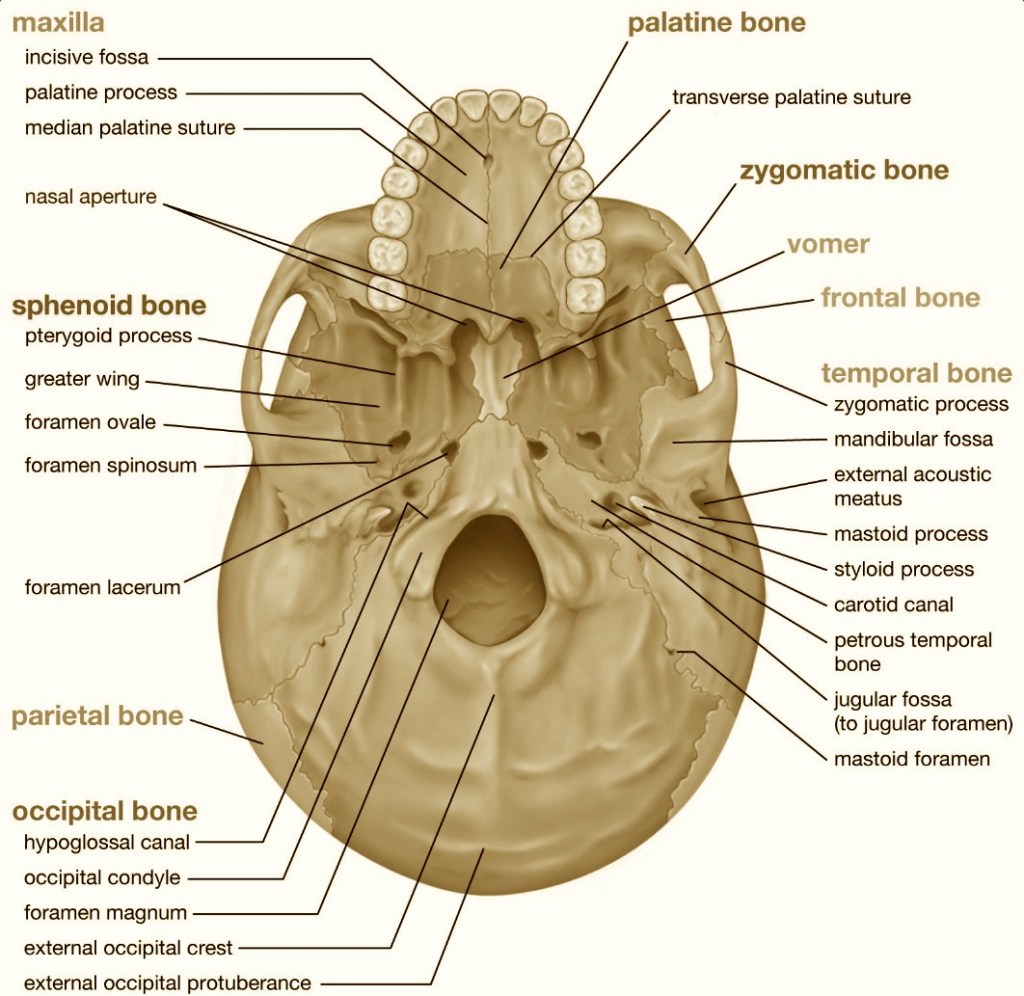
If the frontal bone is round and globular instead of low and slanting, it likely belongs to a female. Finally, we look at the jaw bone (mandible). From below, a u-shaped mandible is indicative of a female and a v-shaped mandible is indicative of a male. Farther down the jaw, the angle of the mandible contains more information. The segment of the bone that is roughly parallel with the neck, when straight, shows that the skull likely belongs to a male. A slanting jaw is likely to belong to a female.
As for long bones, much of the information that hints to one sex or the other references size difference, with male bones being generally longer and larger than female bones. In some cases, there are ranges that are equally possible to belong to either sex.
Of course, much of the time a male skeleton will have some traits that resemble a female skeleton and vice versa. This is true for the determination of height, age, and ethnic origin as well. The purpose of the data collection using qualitative information is to figure out the most probable situation with the resources and information at hand. There are more reliable, quantitative, methods for coming to a conclusion but often they require a more thorough process. It’s common to use online databases of information to compare findings. Overall, using practiced methods, specific measurements, and comparative data, forensic anthropologists can come to strong conclusions with very high accuracy rates and as such their piece in criminal investigations is crucial. Without the input of specialists in anthropology, countless people would still be undiscovered or considered missing, countless families would not have closure, and countless cases would remain unsolved.
 The Hominin Hiker
Leave a comment