
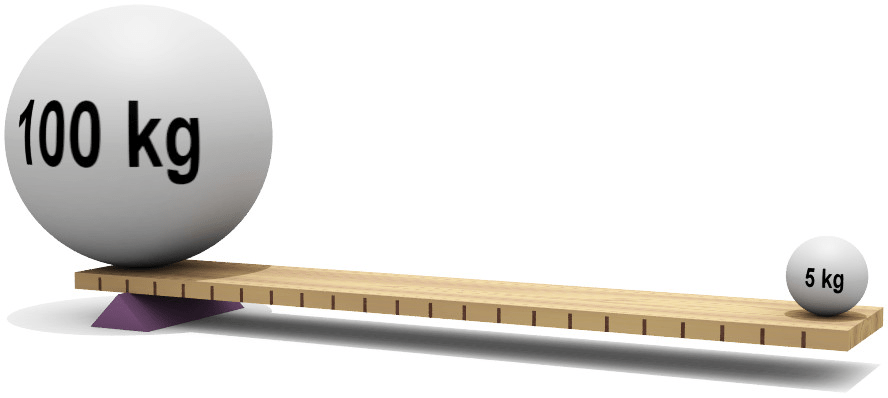
If I were to ask you how your arm works, specifically how your elbow flexes and extends, you could tell me that your muscles cause it to move. And you’re not wrong, they do. But how do they do it? What are they designed for? Physics has a lot to say about movement in our bodies, but let’s start with the elbow.
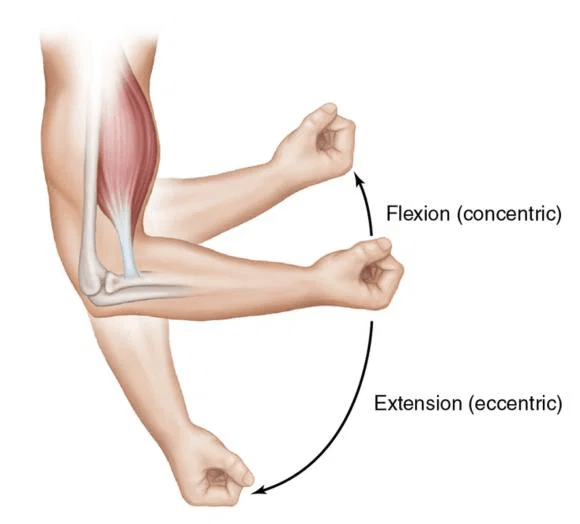
Look down at your arm. You can make it form a straight line, a right angle, or bend it all the way up to your shoulder. This is flexion; you are decreasing the angle of the joint. Now, once your hand can touch your shoulder, you can move your forearm back down to form a straight line again. This is extension; you are increasing the joint’s angle.
When you flex your elbow to move your forearm up, the muscle at work is the bicep. When a muscle is at work, it contracts, becoming shorter and pulling one bone towards another. There are two attachment sites: the origin and the insertion. The insertion is usually found on the more mobile bone. When the muscle contracts the insertion is pulled towards the origin, causing movement at a joint.The bicep has two origins and therefore has two heads (hence the term bi-cep). These two origins attach to the scapula bone in the shoulder. The bone’s insertion is on the radius of the forearm, close to the elbow.
Think of your elbow as a classic first‑class lever, with the joint itself serving as the fulcrum, the forearm acting as the load arm, and the biceps‑tendon as the effort arm. When the biceps contracts it creates a tension force along the tendon that is directed toward its origin on the scapula. Because the insertion on the radius sits a short distance from the fulcrum, the muscle’s line of action generates a relatively large moment arm (the perpendicular distance from the line of force to the elbow). Torque, which is the product of that force and its moment arm (τ = F · r), therefore rises quickly even though the muscle’s absolute force isn’t huge. This mechanical advantage lets the biceps produce enough rotational force to lift the forearm against gravity and any external load. Work done at the joint is simply torque multiplied by the angular displacement, so a few newtons of muscle tension can move the elbow through a large angle while expending only a modest amount of actual, metabolic energy.
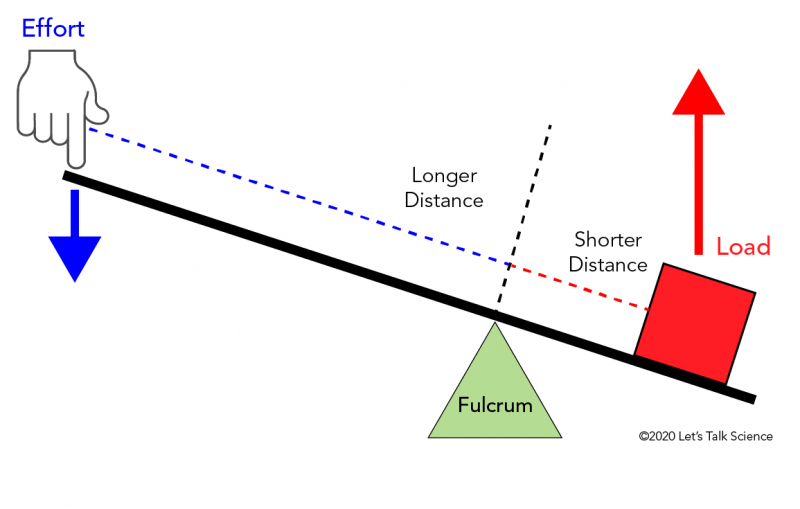
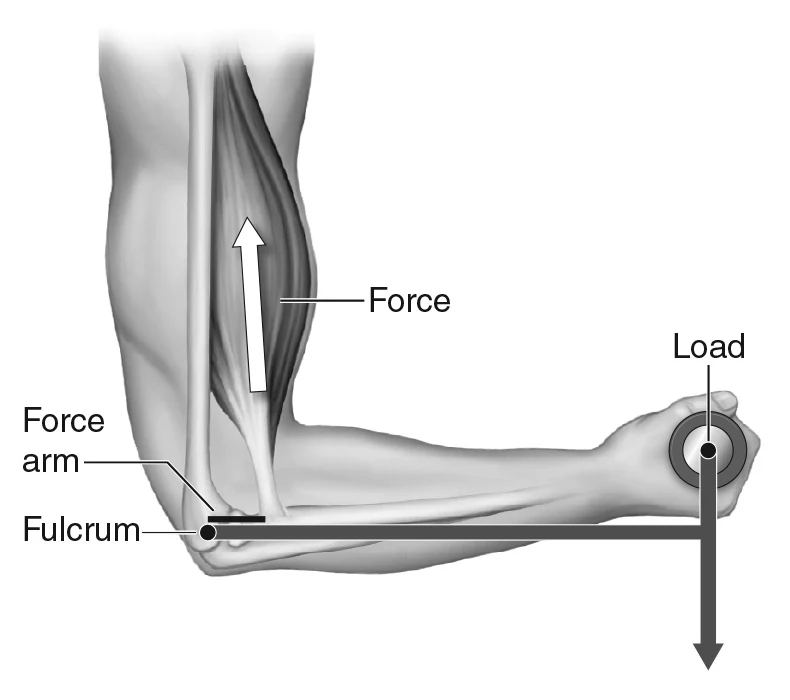
When you straighten the arm, the triceps takes over as the effort arm on the opposite side of the lever. Its insertion on the ulna lies farther from the elbow, giving it a slightly shorter moment arm, but the triceps is a much larger muscle and can generate greater absolute force. The resulting torque opposes the biceps‑generated torque, and the net torque determines whether the elbow flexes, extends, or stays still.
In summary, the elbow works as a first‑class lever: the biceps and triceps create opposing torques by pulling on tendons that have different moment arms, turning muscle force into rotational motion. The principles of physics can explain how our body uses muscles and bones to create smooth flexion and extension machines we use every day.


Leave a Reply